In July 2010, we did a three-day, two-night backpack trip on the Mount Eielson Loop in Denali National Park, Alaska. John was 57 and I was 56.
Denali was unlike other national parks we have backpacked in. At that time, there were relatively few maintained trails, and those were concentrated near the visitor center. When asked where one should go backpacking, park rangers all gave the same response: “There aren’t any trails. You can go anywhere.”
Fortunately, John had read about a route—the Mount Eielson Loop—in Backpacker Magazine. He also had a GPS track, which I found reassuring. The loop is less than 15 miles, which sounds short for three days, but the terrain is rough and travel is slow. Detouring around bears and safely crossing the Thorofare River (twice) was time-consuming. However, the scenery is stunning, so why hurry?
There is one road through Denali that is closed to private vehicles most of the year. One must take a shuttle bus to get to the backcountry. The backcountry is divided into zones, and we were told to let our bus driver know which zone we were headed to so they could drop us off. Fortunately, the route we wanted to do was commonly done, so our driver knew exactly where to let us off. However, there was a young couple on our bus who were not as lucky. When we got to their zone, they asked the driver where they should get off. He gave the standard response: “There aren’t any trails. You can go anywhere.” When we looked outside at their zone, all we saw was dense shrubs and trees. You may be able to go anywhere in Denali, but that doesn’t mean you can get somewhere. Our driver dropped us off at the top of a steep gully, and we were told there was a social trail. We found it and did the steep descent on the muddy trail down towards the riverbed.
Denali has a lot of grizzly bears. Prior to being issued a backcountry permit, we were required to watch a video that included a segment on bear safety. The rangers did an excellent job of educating backpackers on how best to avoid confrontations with bears.
The gist of the video was that bears in the wild, at least within the park, have not learned to associate humans with food, so they are shy and will avoid them whenever possible. We were told that problems occur only when hikers startle a bear, especially a sow with cubs. Bears are not territorial except when in temporary possession of an essential food source, be it a carcass or a berry patch. Hikers are instructed to be aware of situations that could increase the likelihood of a close encounter: brushy trails, berry patches, noisy streams and rivers, being downwind, etc., and are encouraged to call out loudly at intervals.
We had been encouraged to carry binoculars, so once we reached the riverbed, I began scanning the area for bears. Lo and behold, I saw three grizzlies on the other side of the river, a sow and two cubs. Fortunately, they were headed away from where we planned to cross the river and the direction we were headed. So far, so good.

River crossings are common when backpacking in Denali. The photo below is the Teklanika River, but it illustrates the countless braided channels that the glacier-fed rivers form. In order to cross safely, one must spend ample time looking for the shallowest channels and where the current is not too strong.

The glacial water was characteristically cloudy, so we were unable to see the bottom. We had considered bringing water shoes but were concerned they wouldn’t give our feet enough protection. Instead, we decided to wear our boots but without orthotics and socks. Gauging the depth was challenging, but we made this first crossing safely. Our now wet boots felt heavy and less than comfortable, but views such as this one of Mount Brooks soon took our minds off them.

Once across the Thorofare, we headed toward Glacier Creek. We found segments of a social trail and followed it up the creek until we saw three more bears, again a sow with two cubs. However, these bears were less than a quarter of a mile away and near where we were headed.
So, we altered our course to give them a wide berth and had to leave the creek and detour over the Muldrow Glacier (visible to Jean’s right in the photo below). From a distance, the Muldrow does not appear to be a glacier, as it is covered by rocks, soil and brushy vegetation. However, when crossing it, you periodically come across small crevasses that enable you to see the blue glacial ice below.

Once we got up the steep side of the glacier, the primary challenge with this new route was that it required us to repeatedly cross numerous shrubby knolls covered with soapberry shrubs, the grizzly’s favorite food that time of year. Visibility was quite limited, and we were uneasy. We frequently (and loudly) shouted out “HEY BEAR” and banged our trekking poles together, anything to avoid startling a berry-gorging bear. Once we observed fresh bear scat, we became quite nervous and doubled our efforts, which thankfully proved to be effective. I have wondered if any bears were in the vicinity but simply got out of sight until we finally got out of their pantry.
We eventually were able to return to Glacier Creek and continued to follow it upstream until we reached Crystal Creek, which we needed to cross. This was by far the easiest crossing, which is why we felt comfortable having John take photos.

We camped that night in a very broad gravel bed which provided us with excellent visibility.
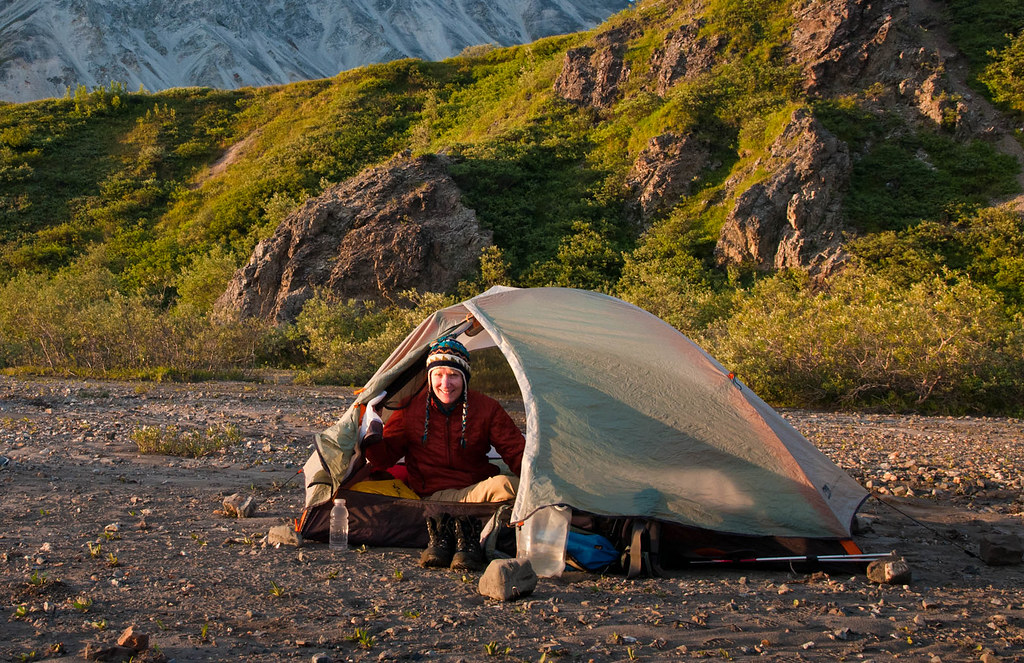
The next morning, John climbed up a nearby ridge for our first view of Denali (AKA Mount McKinley) before the all-too-common afternoon clouds moved in.

We continued on toward Wolverine Creek, which would lead us up to Eielson Pass where we planned to camp that night. On our way up, we met a young couple coming down who had encountered some aggressive wolverines and felt fortunate to have gotten past them safely. While we continued up, we kept a sharp lookout for them, but we didn’t see any. I’m not sure if I felt more disappointed or relieved.

We continued up the canyon as it became steeper and narrower. I kept wondering where we would go if we encountered a bear. The sides of the gully looked too steep to get up. We commonly keep the food that we plan to eat during the day easily accessible in the top pocket of our packs. In Denali, backpackers are instructed to keep all food securely locked in a bear canister unless you are actively eating it. If one encounters a bear while cooking or eating, the instruction is that you slowly back away from the bear, but be sure that you take your food with you. The young couple had done just that. The previous evening, they had been cooking supper when a lone male bear headed down a canyon toward their camp. They said it was challenging, but they picked up their cookpot containing their aromatic supper and backed away. Fortunately, the bear simply gave them a wide berth before continuing down the canyon.
But we reached the pass without incident and were rewarded with outstanding views of the Alaska Range …
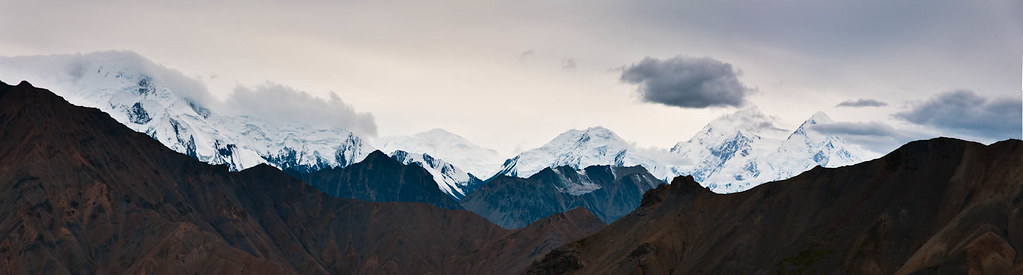
… and Scott Peak.
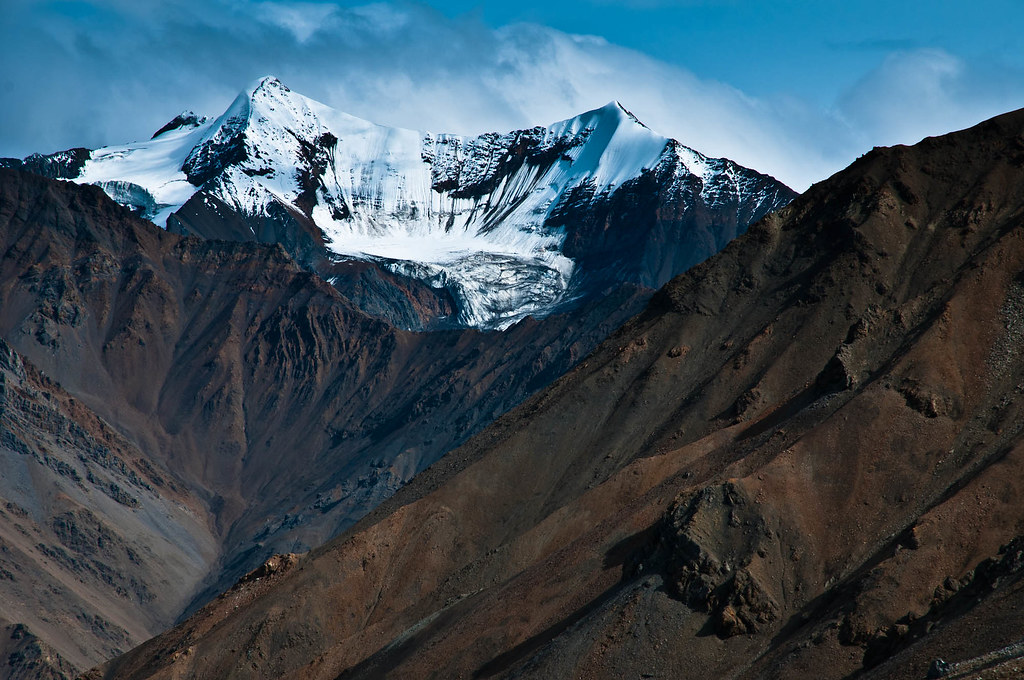
We camped that night at Eielson Pass, which is situated between Mount Eielson and Castle Rock. One concern we had was that there wasn’t anyplace to stash our bear canister where it couldn’t be knocked down a slope below the pass by an enthusiastic bear. However, as there was nothing up there that a bear could possibly want to eat, we didn’t worry too much about it.

As it was late July, the days were quite long, and it was light out when we woke up the next morning at about 4:30 a.m. John got up first as he planned to take photographs of the mountains, especially of Denali in the lovely morning light. He was out of the tent getting his camera ready when I heard him say, with admirable calm, “Hey bear…there’s a bear out here…there are two bears.” I looked outside, saw the sow and cub just as the second cub came into view, and replied, far less calmly, “There’re three bears…Hey Bear!?!” John had initially replaced his camera with his bear spray, but it never became a truly dangerous situation. The sow simply glanced at John before lumbering past, less than 40 feet away, over to the other side of the pass.
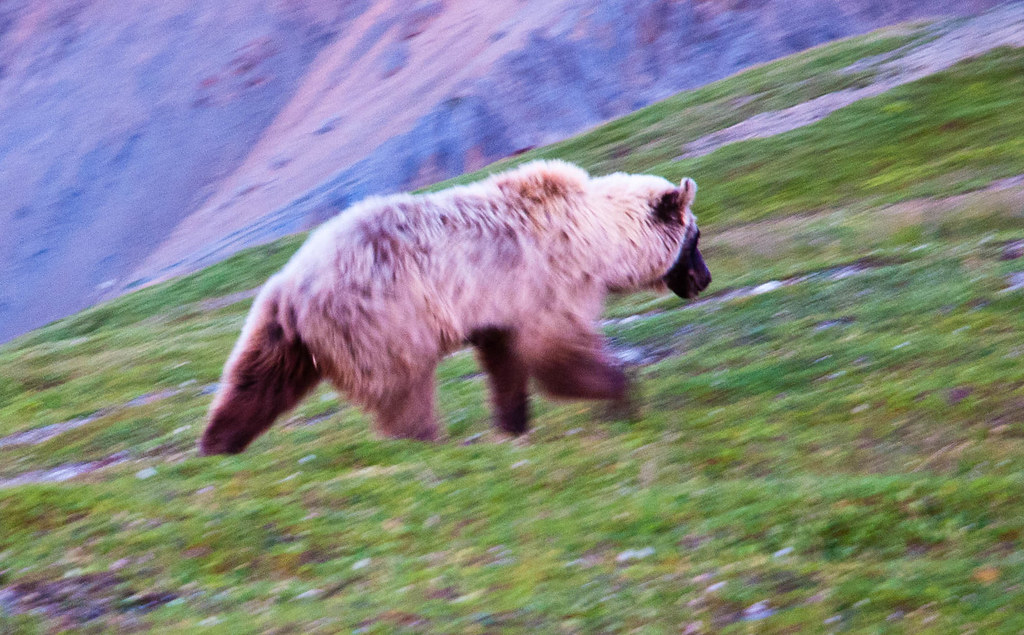
While the cubs seemed curious, neither of them approached us. Much to our relief.

They simply followed their mother down the narrow gully on the other side of the pass, exactly where we had come up the day before.

Our excitement over our bear encounter stayed with us but did not get in the way of our enjoyment of the views of the gorgeous mountains in the clear morning light, including Mount Brooks …

… and Mount Mather.
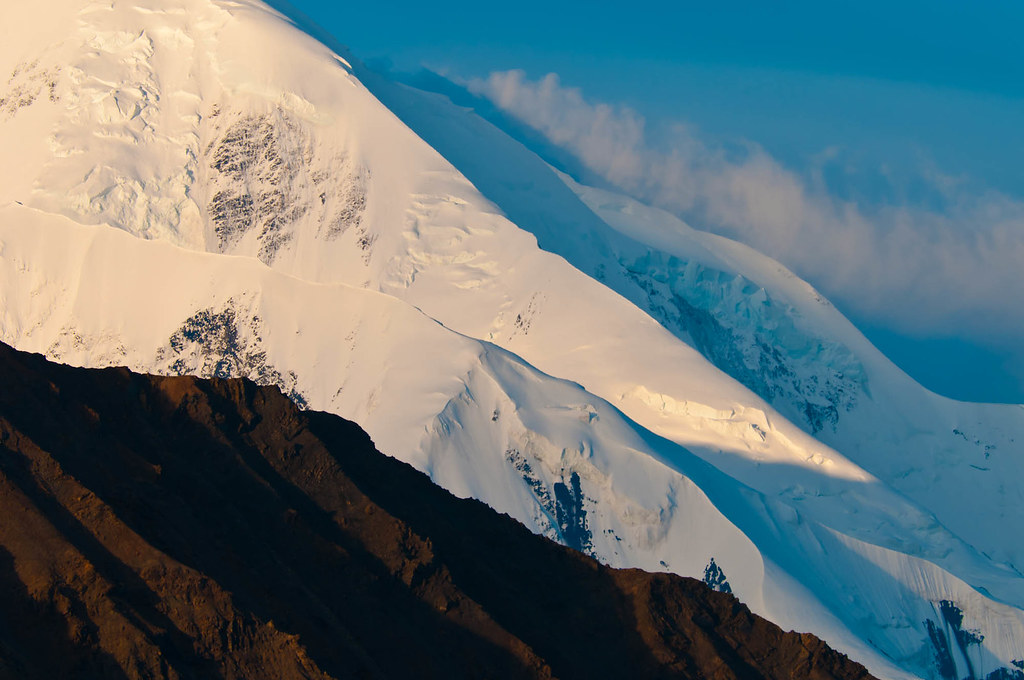
In fact, I think our heightened emotional state added to our excitement over this amazing view of Denali.

After we packed up and were ready to go, we took one last look …
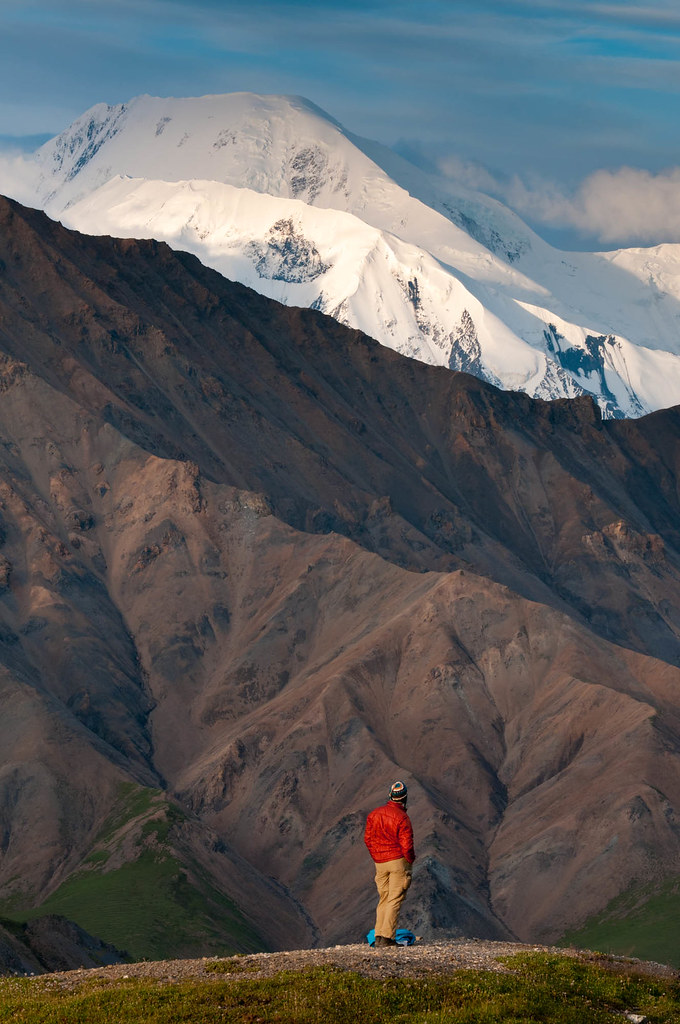
… at the Alaska Range.
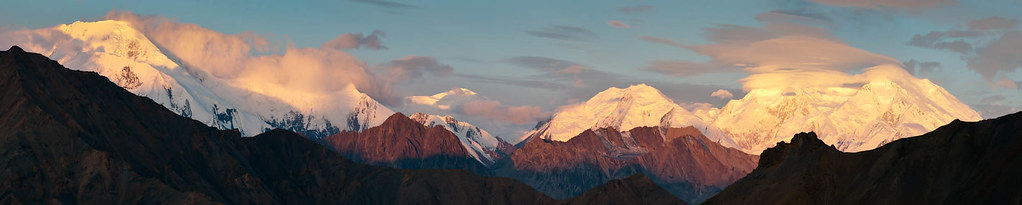
We reluctantly left the pass and headed down the steep gully toward the Thorofare River, which we had to cross again. The young couple we had talked to the day before had told us where they crossed the river, a short way upstream from the base of the gully. However, when we scanned the area, we saw a lone grizzly on the other side of the river quite near to where we would need to come out. Therefore, we had to search farther downstream to where the river was less braided and the channels looked deeper than when we had crossed it on our first day out.
The safest place to cross that we found contained one channel that was deeper and with a much stronger current. Due to the cloudiness of the water, the only way we had to try to gauge the depth was to throw big rocks in and listen for a vague sound of them hitting the bottom. It’s a very imprecise method, but it was the best we had. The water level where we crossed was mid-thigh but not too rocky. However, at one point, our feet were being pushed downstream on loose gravel, as if rolling on ball bearings. It was disconcerting, but we both managed to get across safely and not too wet. I’d love to have a photo of this crossing but, given my poor sense of balance, we both felt it was more important for John to be ready in case I lost my footing.
Once safely across, we followed the river downstream until we located a rough, brushy trail that took us up to the Mount Eielson Visitor Center. We were quite disconcerted to see paw prints heading up the trail but none coming back down. We made lots of noise and frequently looked for escape routes off the trail into the brush. We later heard that bears do approach the visitor center and tourists are kept inside behind locked doors until they finally leave the area. We caught a bus to head back to the main visitor center and were happy to be able to finally let our guard down and no longer feel like prey. Our fellow passengers were disappointed that they had not seen a single bear on the ride to the Mount Eielson Visitor Center. However, as we seemed to be bear magnets, there were several sightings on the bus ride back.
We feel so fortunate for the amazing views we had that morning of Denali. Afternoon clouds are so common that too many park visitors leave without ever seeing it. That is one of the things we love about backpacking—it allows us to be in places with such outstanding views at different times of the day and under different conditions. We have so many great memories from this trip, and our bear encounters will remain peak life experiences.
All photos from this trip are on Flickr.


Leave a Reply