In September 2007 we traveled to Tanzania on the REI Adventures Kilimanjaro Climb and Safari. We spent six days and five nights trekking on the Marangu Route in Kilimanjaro National Park. It was a trip of a lifetime! John was 54 and I was 53.
Mount Kilimanjaro (19,340 feet) has three volcanic cones: Shira, Mawenzi and Kibo. Kibo is the highest, and Uhuru Peak is the highest point on Kibo. Kilimanjaro is the highest freestanding mountain in the world and is elusive, often shrouded in clouds.
When we first arrived at Mount Kilimanjaro National Park, we were introduced to our porters. They are some of the hardest-working people on earth. They are the ones who made this trip possible for us. It is a tradition for porters to sing the “Kilimanjaro Song” to clients at the start of each trek.

When we first met the people in our group, I was dismayed to realize John and I were the oldest ones. It bothered me more than John. He completed the Seattle Mountaineers Beginning and Intermediate Climbing courses and has many challenging and technical ascents under his belt. But I lacked his experience and self-confidence. My fear was that at the end of the day, I would be trailing far behind everyone else. While John had been as high as 14,000 feet, I hadn’t been anywhere near that high. I was concerned about altitude illness.

We spent our first night in the Mandara Huts (8,860 feet).
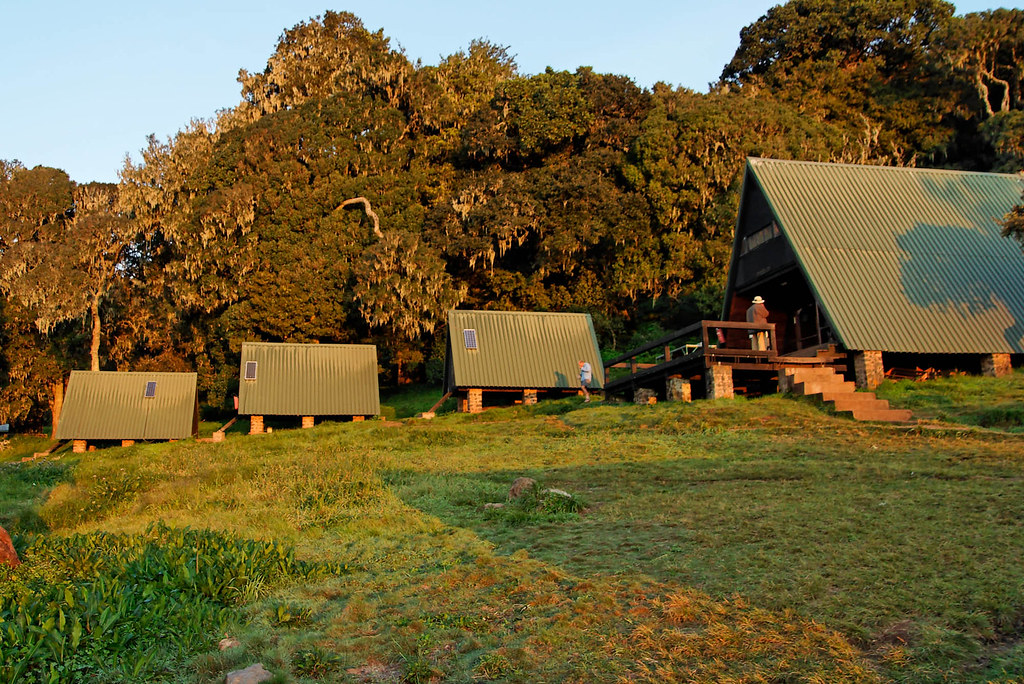
Peter, our guide, explained what he referred to as the internet café, also known as the toilets. He said if we only needed to leave a “short message” during the night, we could just go outside. However, if we needed to leave a “long message,” we should use the toilet.
Each morning, we were awakened by porters bringing us hot tea and serving us in bed.

Once we were up, we were provided with a wash basin of warm water.

This impeccable service continued throughout the day. Hot meals were provided three times a day, even at midday while on the trail. Tables were meticulously set, complete with tablecloths. When we finished a particular dish, someone was right there to offer more. If we looked around, perhaps to locate the thermos of tea, someone was right there offering to help locate it. Once we were done eating, dirty plates were whisked away. After supper, we were even provided with a hot water bottle to take the chill off our sleeping bags.

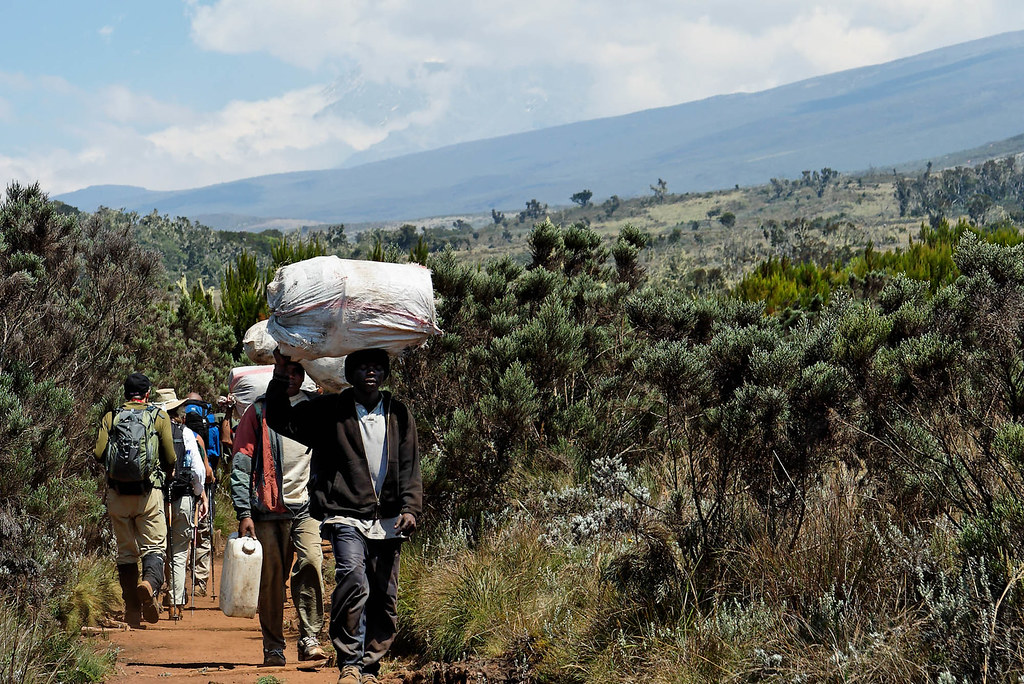
After breakfast, we packed up our gear and handed it off to a porter. We carried daypacks containing only what we would need during the day. We then headed out. The trail passed through a variety of terrain beginning in tropical forest…

… and up through moorland with its unusual giant groundsels.

The first 20 miles are relatively easy for those supported by porters carrying all food and gear. For someone in reasonably good shape, the daily mileage is moderate and elevation gains are modest.
Late in the afternoon, we were welcomed by the sight of Horombo, the huts where we would spend two nights.

John and I shared a hut with the two youngest members of our group, Kevin and Jen.

The next morning, we did an acclimatization hike with Kibo, the highest of Kilimanjaro’s three volcanic cones, in the distance. The trail we would take the next day crossed the saddle behind us on the way to Kibo Hut.
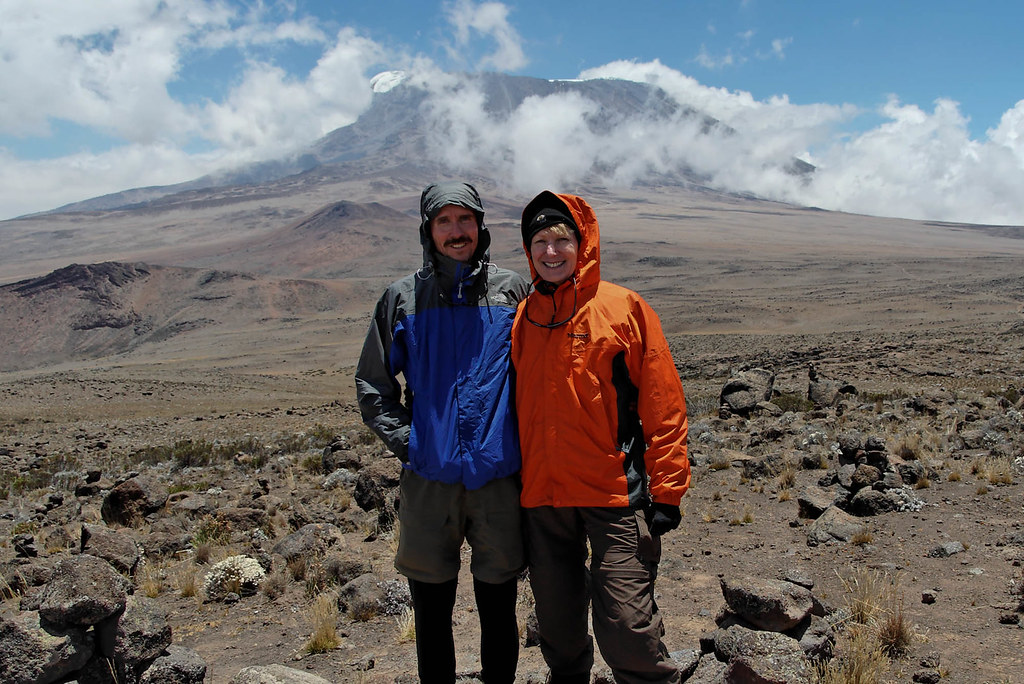
We had a good view of Mawenzi, the second highest of Kilimanjaro’s three volcanic cones.

I began having digestive issues that day. The internet café analogy enabled us to discuss the subject without getting too graphic. My long messages lacked punctuation, but I carried the necessary antibiotics. I knew every effort was being made to prevent foodborne illnesses. Porters were carrying all our drinking water. However, other water was collected from a nearby stream. Our porters did their best, but our food was being prepared under challenging circumstances.

The following morning, we left Horombo and headed to the next hut, Kibo. There was a constant stream of people, trekkers and porters, going up and coming back down.
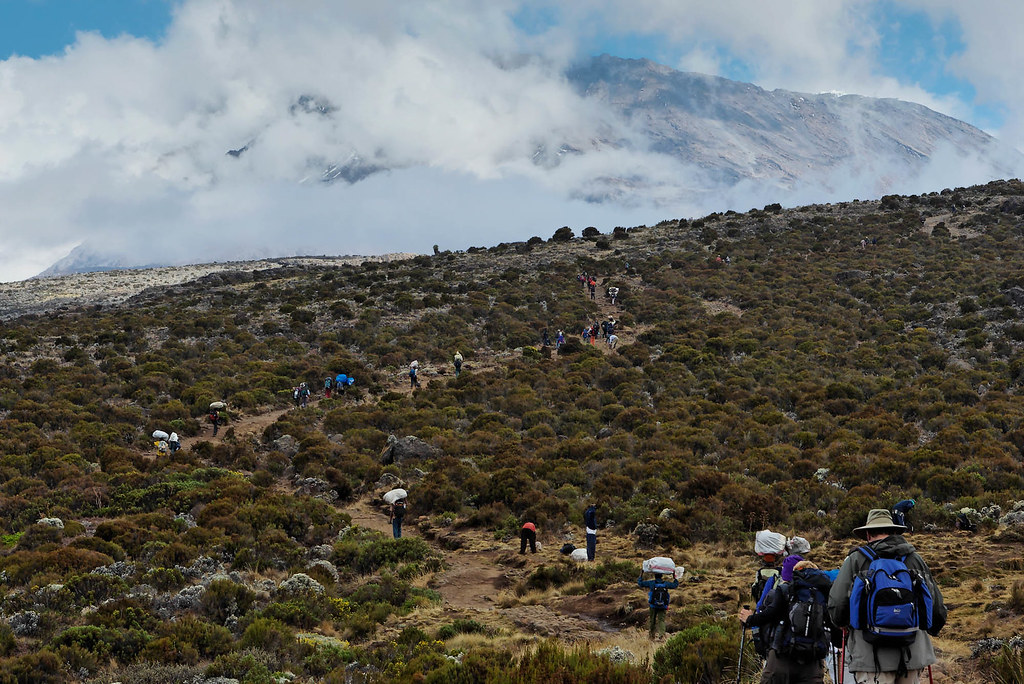
The trail from Horombo crosses the broad saddle between Kibo and Mawenzi.

The trail to the summit is barely visible in the middle of the photo. The trail to Uhuru switchbacks up the steep scree slope for five miles and gains 3,820 feet. Uhuru is barely visible at upper left.

We arrived at Kibo Hut (15,520 feet) in midafternoon. After eating an early supper, we were instructed to try to sleep for a few hours. Unfortunately, John began feeling ill. He was unable to eat and felt nauseous. He has had issues with altitude illness in the past but nothing that stopped him from completing a climb. After he threw up, I became quite concerned. John is not one to give up, and my heart sank when he said to me, “I don’t think I can make it. And the sad part is I don’t even care.” However, our guide was confident he could get to the summit. He told me, “He will sleep and then he will be like lion. You must believe this.” I said I would try to believe it, but it was most important that John believed it.
We all went to bed and were awakened at 10 p.m. to try to eat again. Fortunately, John was feeling better and was planning to go with us. Our final push for the summit began before midnight, in bitter cold. We soon began the countless switchbacks up the steep scree for 3,820 feet of elevation gain. Hiking with a headlamp creates its own otherworldly sensation, and it was magnified by the sight of lights from innumerable other headlamps snaking up the slope both above and below us.
Our porters were extremely attentive. They carried our packs and helped us when it was time to drink something. I so appreciated not having to remove my heavy mittens in the bitter cold. My porter would get out my water bottle and hold it up to my lips. I never felt more pampered in my life. While John and I had seemingly recovered from our respective health issues, most of the rest of our group felt poorly on the ascent. Their porters were equally attentive. One woman needed to leave urgent long messages, and her porter held her hands throughout the uncomfortable composition.
The sky lightened very gradually. We arrived at Gilman’s Point (18,685 feet) in daylight just in time to get a brief view of the crater before the clouds moved in and completely covered it. While the others in our group rested at Gilman’s Point, John and I continued toward the summit. We were right behind Kevin, the most physically fit in our group. Then John decided to wait for Peter, our guide, who was carrying his pack so he could retrieve his camera. I kept trudging along behind Kevin. Then he stopped. He had begun to feel sick and stepped off the trail.
I was shocked to find myself alone as I continued. I walked slowly, taking two breaths for every step. Just as I reached the summit (19,340 feet), the clouds broke and the sun shone on the glacier. The beauty of the light reflecting off the glacial ice caused me to burst into tears, which promptly froze on my eyelashes. It was an interesting sensation but one that I don’t care to repeat.
While I was standing on the summit of Mount Kilimanjaro, I realized I wasn’t the only person crying. There was a young woman who tearfully said to her companion, “When I lost my leg a year ago, I never thought I’d climb Kilimanjaro.” Her left leg had been amputated above the knee, and she had just hiked over 24 miles and gained more than 13,000 feet with a prosthesis.
Once John retrieved his camera, he could start trying to capture the views of the glacier.

There has been concern that Kilimanjaro’s glaciers are receding. We were told they weren’t melting so much as evaporating.
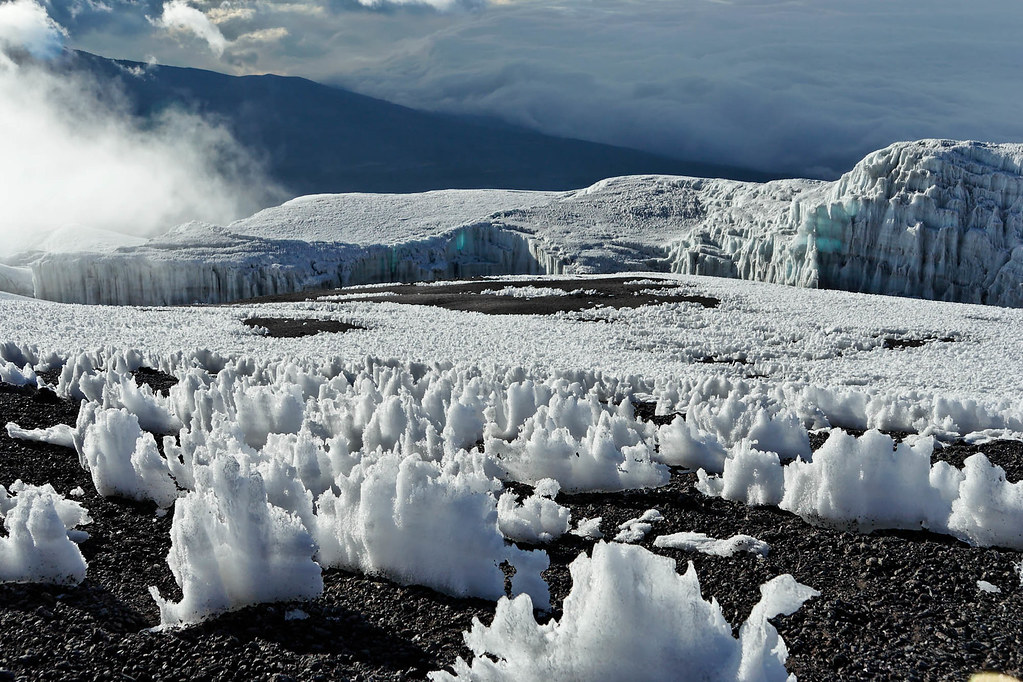
We felt so grateful to have seen the glacier that was still there.

Everyone on the summit waited patiently in line for the requisite photo with the sign. Interestingly enough, the sign does not say Mount Kilimanjaro.
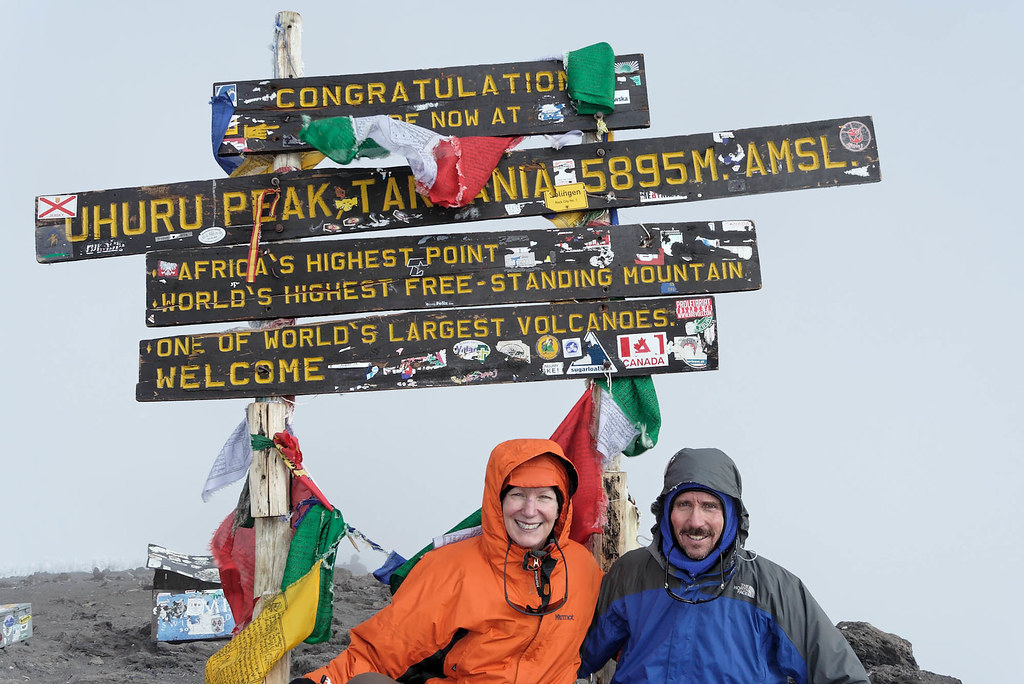
As it approached midday, the clouds began moving in and it was time to head down.

The descent was much faster. Rather than hike on the trail with its innumerable switchbacks through the scree, we were encouraged to plunge-step straight down. We spent that night at Horombo and hiked all the way out the following day.
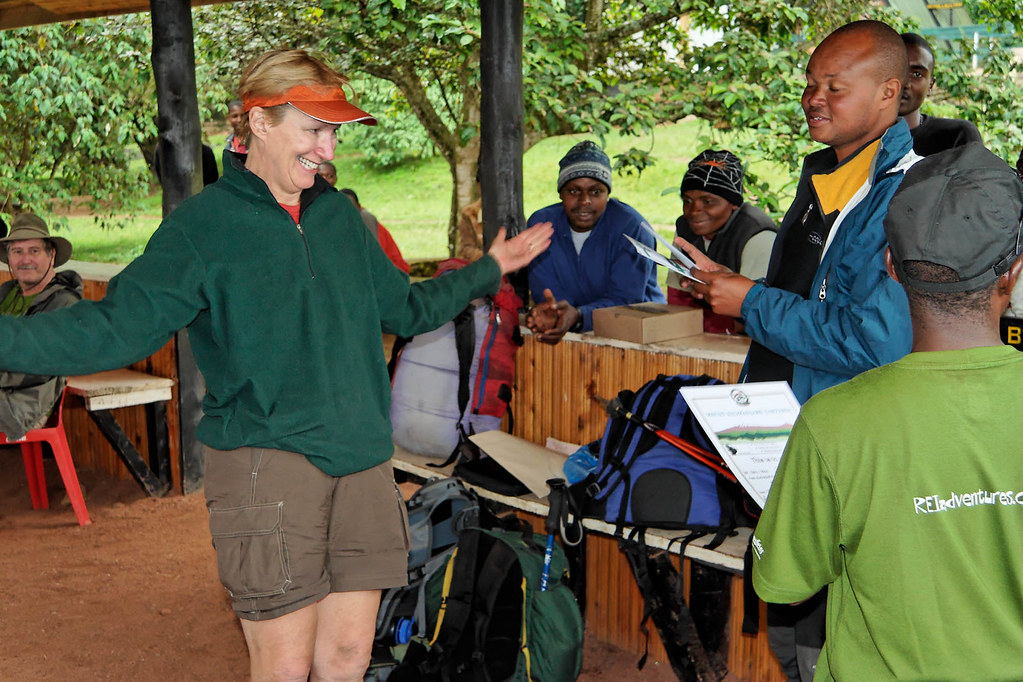
Once down, our porters gathered around and sang to us while each of us was presented with a certificate.
Shortly before we left the area to begin our safari, we got one last view of Mount Kilimanjaro.

I have never forgotten that young woman I overheard on the summit. It was a humbling experience then, but remembering it has inspired me. I’ve decided that if she could overcome the loss of a leg and put her mind to climbing Mount Kilimanjaro, then the least I can do is not focus on what I might not be able to do. Instead, I can be grateful for my two feet, that have many issues, and my two arthritic knees that are attached to two whole legs. I can follow her example and help compensate for physical liabilities with mental toughness and determination.
I believe reaching the summit was a bigger deal for me than it was for John. It proved to me that I’m tougher than I think I am. Reaching it before anyone else in our group taught me that I don’t have to define myself by my age. Kilimanjaro is such an iconic mountain, and reaching the summit earns one some bragging rights. I’ve discovered how easy it can be to just slip it into conversations with younger backpackers.
All photos from this trip are on Flickr.


Leave a Reply